
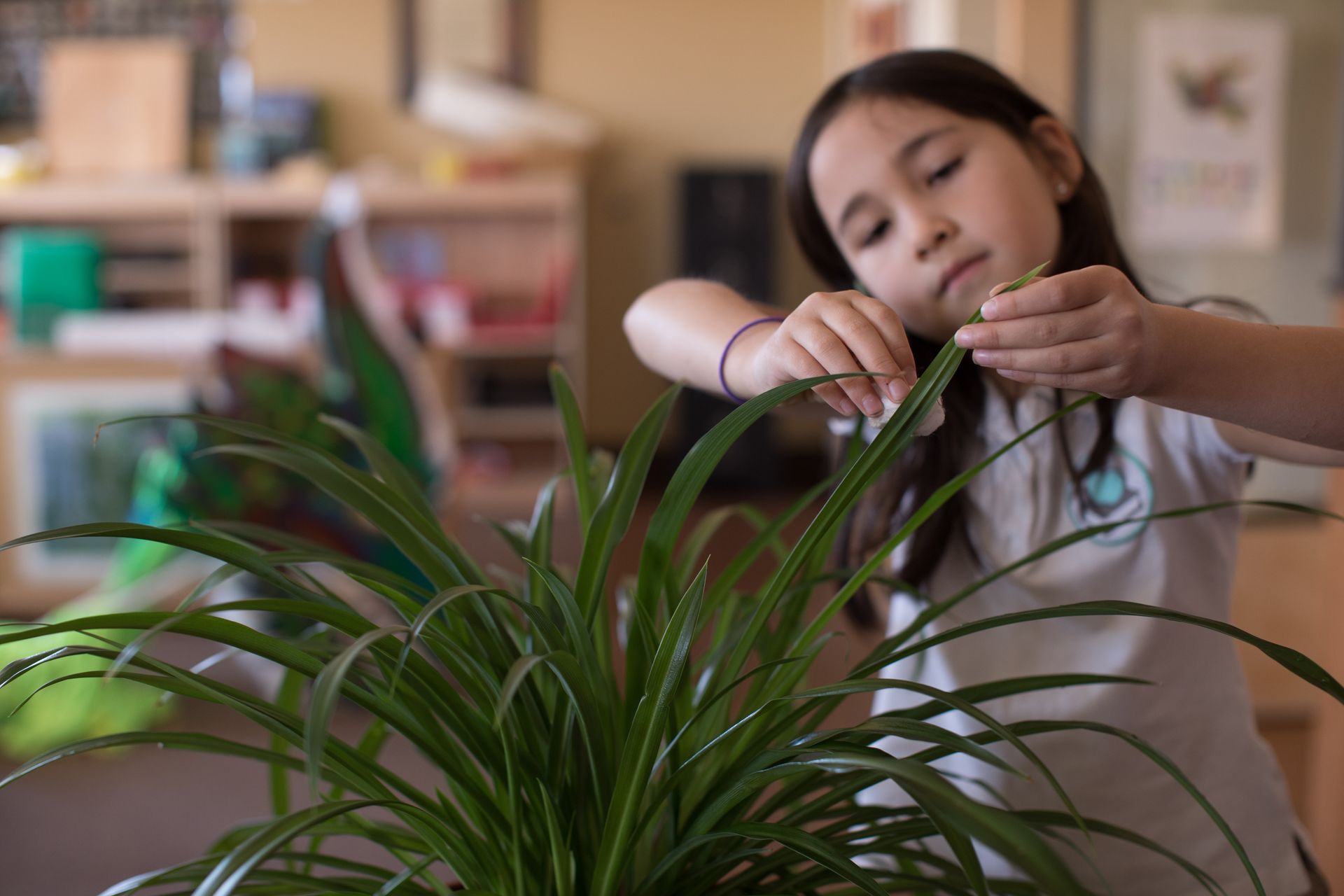
When people picture a primary classroom, some of the most recognizable materials that come to mind are the practical life works. You might envision small wooden trays with pouring and transferring exercises, child-sized flower arranging stations, or dressing frames for mastering buttons and ties.
At the primary level, these materials are distinct and highly visible on the shelves. Because of this, it can sometimes appear that practical life is a component of education reserved only for children up to age six.
What happens as children move into the elementary years and beyond?
Practical life work does not stop, nor does it diminish in importance. Instead, it naturally evolves, blending into the broader curriculum to match the child's changing developmental needs. Learning to organize a complex multi-week research project or manage a group budget serves the exact same purpose as learning to tie a shoe: building self-reliance, capability, and functional independence.
Here is a look at how practical life skills unfold for older students in our learning environments.
1. Time Management & Goal Setting
No one is born automatically knowing how to structure their time. Managing time requires a clear awareness of duration, the ability to break large goals into smaller steps, and the discipline to follow a plan.
In the elementary classroom, this work often centers around a personalized work plan. A work plan outlines the core tasks and research goals a student aims to accomplish over the day or week. While the expectations are set collaboratively with the guide, the student retains freedom over their workflow and sequencing.
Learning to manage time is a gradual process that involves real-world trial and error:
- Navigating unfinished work: It is common for an elementary student to focus heavily on language tasks early in the week, only to realize on Friday morning that their math work remains untouched.
- Collaborative reflection: Rather than issuing a punitive response, the guide uses this moment for a supportive check-in. Together, the guide and student explore the root cause: Is the math material too challenging? Is it lacking interest? How can we structure your morning so you tackle this first next week?
- Developing self-regulation: Through these regular touchpoints, students learn to identify personal habits, adjust their pacing, and take ownership of their learning rhythm.
2. Social Coordination & Community Problem-Solving
As children transition from the lower elementary years into upper elementary and adolescence, their social drives expand rapidly. Parallel play gives way to deep peer relationships, collaborative group projects, and a developing sense of social justice. With deeper social dynamics naturally come opportunities to practice conflict resolution.
The flexible structure of the morning work cycle allows community needs to be addressed in real time:
- Community meetings: If a challenge arises during outdoor play or collaborative group work, the community can gather for a class meeting. Rather than imposing adult rules, the guide facilitates a structured conversation where students share observations and brainstorm actionable solutions.
- Micro-mediations: When individual conflicts occur, students are guided through peaceful dialogue, learning to express their boundaries, listen actively, and reach mutual agreements.
- Quiet reflection spaces: Classrooms include quiet areas where students can independently pause, regulate their emotions, and rejoin the group when they feel ready.
3. Advanced Self-Care & Physical Well-Being
Self-care in the second plane of development expands beyond basic personal hygiene to include a broader understanding of physical and mental health.
- Nutrition and food preparation: Students take on greater responsibility for preparing shared community snacks, exploring regional recipes tied to geography studies, and managing their own snack timing within agreed-upon classroom guidelines.
- Physical movement: Developing healthy movement habits remains integral to daily life. Students engage in movement through outdoor exploration, cooperative games, yoga, and mindful stretching breaks throughout the day.
- Stress regulation: Students are introduced to practical techniques for managing frustration and academic challenges, including breathing exercises, journaling, and mindful reflection.
4. Practical Microeconomies & Real-World Application
As students approach adolescence, practical life expands directly into the surrounding community. At this stage, practical life often takes the form of a student-run microeconomy or entrepreneurial enterprise, such as managing a campus garden, operating a seasonal market, or hosting a community cafe.
Under the mentorship of their guides, students take ownership of authentic operational responsibilities:
- Communicating with local suppliers and placing orders
- Managing income, expenses, and balancing a project budget
- Creating informational signs, flyers, and announcements
- Organizing logistics, team roles, and customer service
Building Capable, Independent Adults
Practical life is not a static subject confined to early childhood; it is a continuous thread running through every stage of development. By offering authentic responsibilities as children grow, we help them develop the confidence, resilience, and practical skills needed to navigate the wider world.
Explore Our Programs
To learn more about how practical life skills are integrated across our primary and elementary classrooms, we invite you to connect with Mission Montessori Academy to schedule a school tour.