
"The mind takes some time to develop interest, to be set in motion, to get warmed up into a subject, to attain a state of profitable work. If at this time there is interruption, not only is a period of profitable work lost, but the interruption produces an unpleasant sensation which is identical to fatigue.”
— Dr. Maria Montessori, What You Should Know About Your Child
Consider what it takes for you as an adult to produce your best work. What does your space need to feel like? What conditions allow you to settle in, reach a state of flow, and accomplish your goals without unnecessary friction?
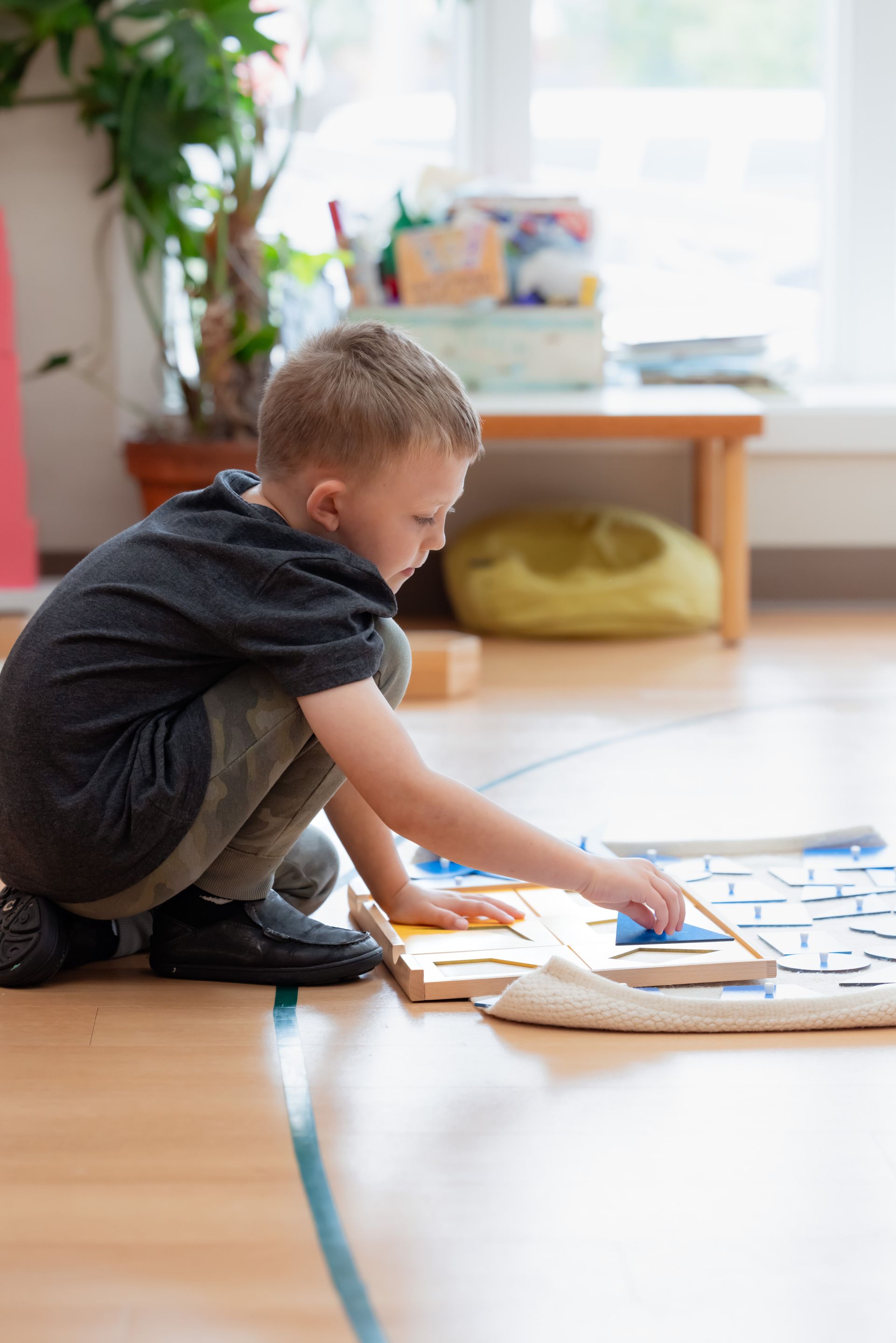
When observing young children, it becomes clear that deep learning happens organically when they are given the freedom to engage with purposeful activity. Given time without arbitrary interruptions, children demonstrate an extraordinary capacity for sustained focus. They possess an innate drive to tackle challenges, work through solutions independently, and experience the genuine satisfaction that comes from internal motivation rather than external rewards or pressure.
Children do not require constant redirection or incentives to engage in meaningful learning. What they truly need is time, adult respect, and a thoughtfully prepared environment that protects their concentration.
This principle is why the extended morning work cycle—typically spanning roughly three hours—serves as a core foundation of our daily rhythm at Mission Montessori Academy.
How the Work Cycle Begins
The morning work cycle begins as children enter the classroom community. Depending on the developmental plane of the environment, the day may open with a brief gathering or transition directly into self-selected work.
A child’s morning routine involves practical, purposeful steps: hanging up their coat, changing into indoor shoes, and greeting their teachers and peers. From there, the child enters the prepared space with clear intent. One child may select a material from the shelf immediately, eager to return to a project started the day before, while another takes a quiet moment to observe the room before making a choice.
- Primary level: Children under age six typically choose individual work nearby their peers. They carry a rug to define their space, arrange their material, and enter a state of quiet focus. When finished, they return the material to its exact place on the shelf, restored for the next person.
- Elementary level: Older children, driven by a growing social consciousness, often begin their morning in collaborative pairs or small groups. While their start may involve more discussion and joint planning, the focus remains centered on meaningful, self-directed projects.
The Role of the Adults in the Room
In a Montessori classroom, the adults function as observers, facilitators, and guides rather than traditional lecturers. The environment is maintained by two primary roles working in tandem:
- The Classroom Assistant: Keeps the physical environment orderly, ensures materials are complete and accessible, and offers subtle support that preserves the child's independence.
- The Lead Guide: Focuses on observing individual development and presenting targeted lessons to individuals or small groups.
Lessons are offered quietly and unobtrusively without interrupting the rest of the room. Rather than calling a student away from a task mid-step, guides use gentle, non-verbal touchpoints—such as leaving a small marker at the child's workspace—signaling the child to check in whenever they reach a natural stopping point in their current activity.
Natural Rhythm, Independence, and "False Fatigue"
Does a child remain intensely focused for three hours without stopping? Naturally, no. Just as adults take short breaks to maintain productivity, children move through a natural ebb and flow of energy during the morning.
Our environments are prepared so children can meet their own physical needs independently. A child may pause to eat a light snack at the snack table, pour a glass of water, use the restroom, or gaze out the window to rest their eyes. Because they do not need to ask permission for basic bodily needs, they learn to self-regulate and honor their own natural rhythms.
Understanding "False Fatigue"
Around mid-morning—often between 10:00 and 10:30 AM—classrooms frequently experience a phenomenon known as false fatigue. During this brief window, the ambient volume in the room may rise, children may move about more frequently, and focus appears to dip across the room.
While the natural impulse might be to intervene or regain control, experienced educators know to pause, observe, and wait. Given a few quiet minutes to reset on their own, the children naturally settle back down, entering an even deeper level of concentration for the remainder of the cycle.
A Window into a Child's Morning
A single morning work cycle offers a rich mix of focused concentration and physical balance. Over the course of three hours, a child might:
- Complete two or three self-selected activities across math, language, or practical life.
- Receive an individualized presentation from their guide on a new concept.
- Prepare and eat a snack, washing their own dish afterward.
- Collaborate with a classmate on a shared exercise or observe a peer at work.
- Take brief, self-directed rest moments whenever needed.
The long work cycle is ultimately an expression of trust. By providing the time, space, and freedom for children to direct their own effort, we honor their capacity for deep work and self-discipline.
Experience the Work Cycle Firsthand
Observing a morning work cycle in person is the clearest way to understand how order, freedom, and concentration flourish in a prepared environment. We invite you to schedule a classroom observation.