Parents whose children are in their second year of a Primary classroom often find themselves facing a significant crossroad: Should my child remain at Mission Montessori Academy for their final Kindergarten year, or transition to our local public school?
We understand how deeply parents ponder this decision. It is natural to evaluate the investment of private Kindergarten when free public options exist. Other families wonder if making the transition now makes sense since their child won’t be in a Montessori environment forever. At the same time, leaving Mission Montessori Academy is a hard thought to entertain because families feel the distinct, nurturing, and transformational quality of this educational approach.
Here is a closer look at what makes the third and final year of the Primary cycle—the Kindergarten year—so extraordinary.
Learning for Mastery
Montessori classrooms are intentionally designed around a three-year developmental cycle. While the benefits of this structure are vast, one of the greatest advantages is providing third-year students with opportunities they simply cannot experience anywhere else.
Having spent two years laying a strong foundation, the third year is where everything clicks into place. The Montessori curriculum consists of carefully sequenced materials designed to culminate in a powerful third-year experience:
- From Fine Motor Prep to Writing: The time spent grasping knobbed cylinders, tracing metal insets, and practicing sandpaper letters bears fruit as the third-year child comfortably writes on paper with confidence and control.
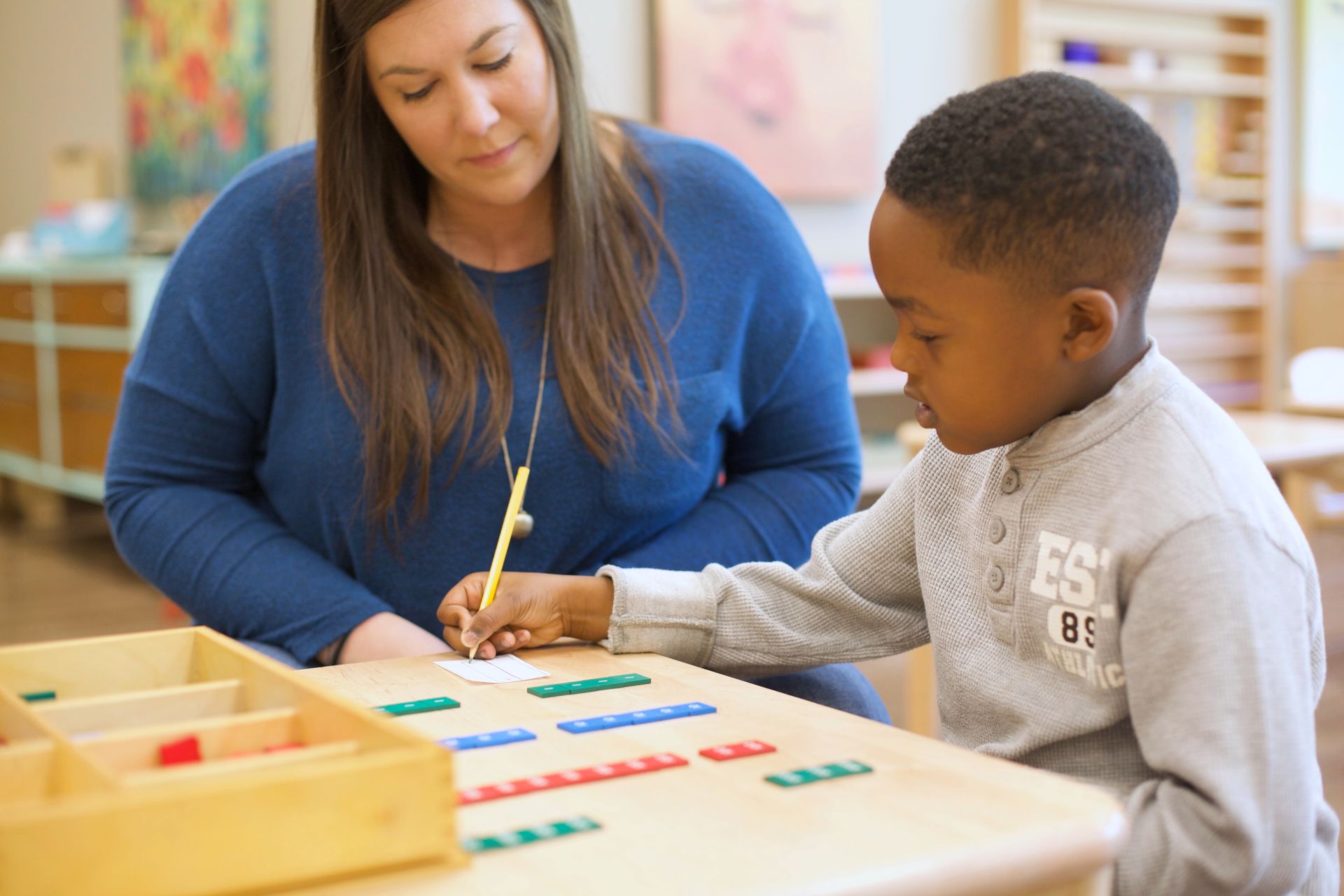
- From Concrete Math to Deep Understanding: Years of early mathematical preparation lead to exciting work with the Golden Beads or Stamp Game, where kindergartners confidently perform addition and subtraction into the thousands.
- From Sounds to Reading: By emphasizing phonetic sounds rather than letter names from the start, many children naturally transition into reading during this final Primary year.
Children as Independent Leaders
During the third year, children do not just master skills independently—they become leaders and mentors to their younger peers. In education, it is widely recognized that when a child can teach a concept to someone else, true mastery has been achieved.
When a third-year child guides a younger classmate through a work, they reinforce their own understanding while building authentic self-confidence. They do not need artificial praise to feel successful; they feel it intrinsically.
This peer-led learning goes beyond academics. Teaching a friend cultivates empathy, patience, and kindness, shaping children into thoughtful citizens of their classroom community.
Fueling the Internal Spark
At Mission Montessori Academy, one of our fundamental goals is to keep the joy of discovery alive. We honor each child as a unique individual, knowing that traditional, one-size-fits-all approaches can inadvertently extinguish a child's natural curiosity.
Rather than drilling facts or assigning identical tasks to every child, we prepare an environment where children can make discoveries for themselves. Our guides provide individualized lessons and gentle guidance, offering children the freedom to follow their interests deeply while ensuring balanced educational growth.
Key Differences: Montessori vs. Conventional Education
To help illustrate what sets this year apart, consider how the daily experience differs from a conventional environment:
- Assessment: While conventional settings often rely on frequent standardized testing at a young age, Montessori guides track progress through continuous, careful observation and detailed record-keeping.
- The Learning Space: Instead of assigned seating at fixed desks, children choose where to work—whether at a small table or on a cozy work rug on the floor.
- Motivation: Conventional approaches frequently rely on external motivators like sticker charts, prizes, and grades. Montessori nurtures intrinsic motivation, relying on beautiful, engaging materials and the natural joy of completion.
- The Role of the Educator: Rather than the teacher being the central focus of the classroom, the children are at the center. The guide offers precise individual lessons, then steps back to let independent learning flourish.
- The Ultimate Goal: Traditional schooling often focuses primarily on meeting standard benchmarks. Mission Montessori Academy focuses on cultivating curious, empathetic lifelong learners who are prepared for the world ahead.
Let’s Connect
Deciding on your child’s Kindergarten year is a meaningful step in their educational journey. We are here to support you, answer your questions, and walk through this decision together.
Want to learn more about the third-year experience?
Contact our administrative team today to schedule an observation or set up a time to talk.