Easing the Transition: A Guide to Starting the School Year

August 4, 2025

As summer winds down and the school year approaches, our children often experience a mix of emotions from excitement and curiosity to worry and anxiety. Whether your child is returning to familiar routines or stepping into something entirely new, transitions can be challenging for both children and parents.


The good news? With a little forethought and gentle structure, the shift from summer to school can become an opportunity for growth, connection, and calm. The Montessori philosophy reminds us that preparing the environment is key, and that includes preparing our home routines, emotional landscape, and mindset for the change ahead.


Reestablishing Routines


One of the most effective ways to support a smooth transition is to gradually reintroduce routines. Children thrive on consistency and predictability, and reestablishing a gentle rhythm can reduce stress and help everyone feel more grounded.


Sleep Schedules


The shift from late summer nights to early school mornings is often the trickiest. Rather than expecting a sudden adjustment on the first day, we recommend starting 10 to 14 days in advance. Gradually move bedtimes and wake-up times earlier in 15-minute increments. The goal is for your child to wake feeling rested and ready when the school year begins. Pair this adjustment with a calming, age-appropriate bedtime routine to support both physical rest and emotional regulation.


Morning Routines


A consistent and peaceful morning routine can transform the start of the day for the entire family. With a few subtle adjustments, we can also encourage our children to participate in preparing for the day ahead. For example, offer two outfit options for younger children, or encourage older children to choose and lay out their clothes the night before. A visual checklist with steps like getting dressed, eating breakfast, brushing teeth, and packing up can help alleviate the pressure. For added fun and independence, laminate the visual guide and let your child check off each task with a dry-erase marker. Ultimately, it helps practice the morning routine together before school starts, so it feels familiar and low-pressure.


Preparing Lunches and Snacks


Involving children in packing their own lunch fosters independence and gives them a sense of responsibility. Set up a small shelf or refrigerator section with healthy, ready-to-grab options. With a little support, even very young children can help pack their snacks and lunches the night before or as part of the morning routine.


Creating Calm and Order at Home


Designating a special area for school items helps build a sense of order and capability. Low hooks for backpacks, a bin for shoes, and a tidy shelf for lunch bags or outerwear give your child the tools they need to manage their belongings independently.

You can even “practice” coming home before the first day of school. Having your child hang up their backpack, unpack their lunch, and put things away helps establish habits that will carry through the year.


Supporting Emotions


It’s completely normal for children (and us!) to feel a mix of emotions about returning to school, especially when starting somewhere new. The key is to remain open, curious, and validating.


Encourage open conversations about feelings that might be arising. Instead of trying to fix discomfort, try reflective listening: “It sounds like you’re feeling a little nervous about meeting new friends.” We can also model a positive mindset by highlighting joyful aspects of school, such as reconnecting with friends, engaging in favorite activities, or exploring something new.


Another approach is to create rituals to mark the transition, such as an end-of-summer breakfast, a special note tucked into a lunchbox, or a celebration to mark the start of the school year.


Cultivating Connection


Transitions are smoother when children feel supported and connected to their community. If possible, visit the school before the first day, especially if your child is starting something new. Even a walk around the outside of the building can provide helpful familiarity. Coordinating playdates or meetups with classmates can help build or rebuild social bonds. If your child is interested, it can also be fun to explore extracurricular activities that foster a sense of belonging.


Maintaining Wellness and Balance


We do better when we feel better. To help children sustain their energy for the school day, focus on nutritious meals, especially a healthy breakfast that will fuel concentration and energy. To support a healthy balance between screen time, movement, and rest, work with your child to establish technology boundaries and screen limits before the school year starts. This helps children adjust ahead of time to different (and hopefully healthier) habits.


Encouraging Independence and Collaboration


Back-to-school doesn’t have to be something adults “do to” children. When we invite children into the process with genuine collaboration, they begin to feel more in control and more confident. From setting up routines, to preparing meals, to expressing their feelings, children are capable of contributing meaningfully to the process.


The result? A smoother transition, a greater sense of peace, and children who feel ready to step confidently into the school year ahead. 


Curious to learn more about supporting children in developing habits that serve them for a lifetime? Visit our school today!


Pumpkins stacked on wooden pallets at an outdoor market stall
October 5, 2026
Discover Montessori-aligned ways to celebrate autumn with your child! Explore hands-on pumpkin activities, practical life kitchen skills, life cycle lessons, and seasonal math for young learners.
September 28, 2026
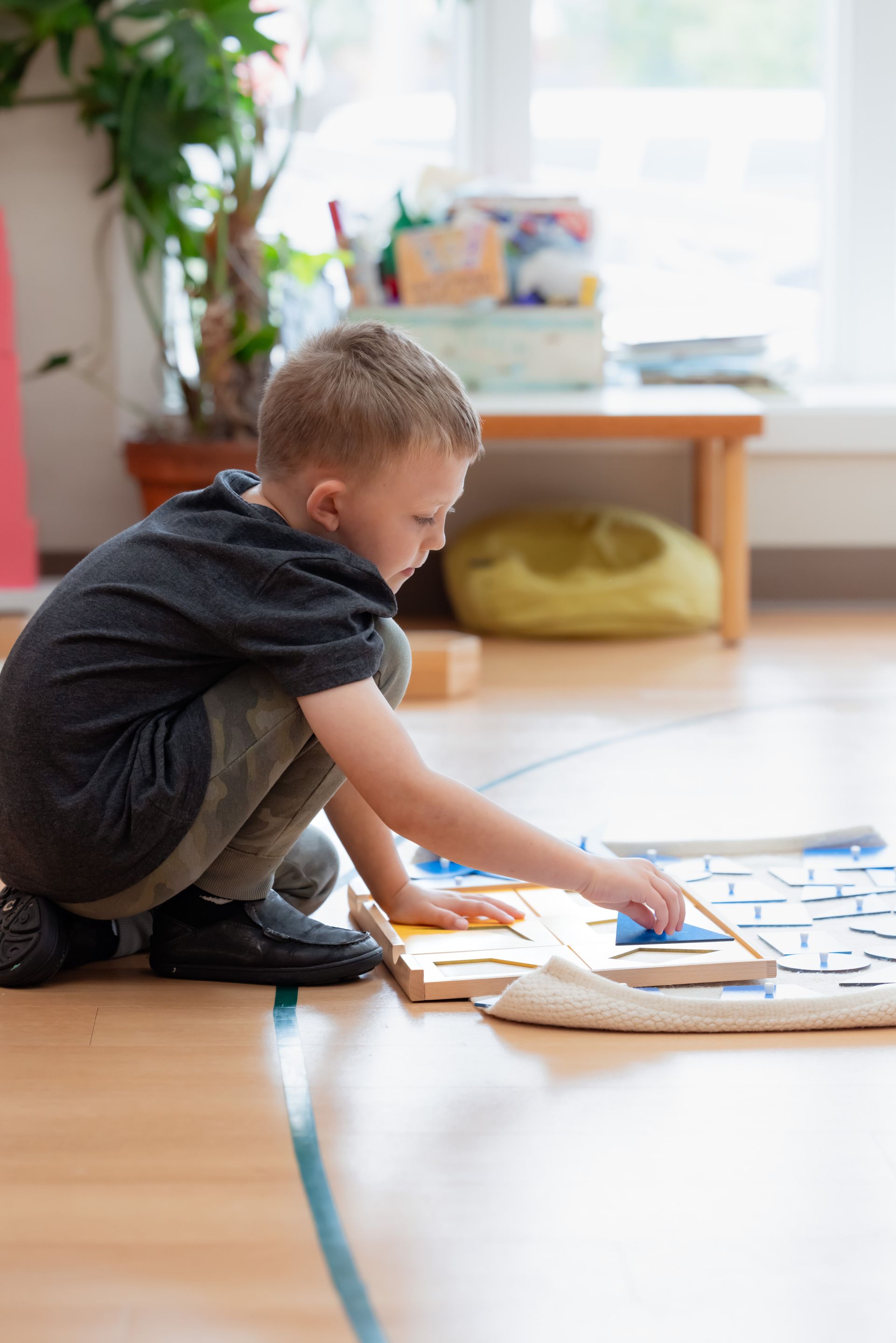
Nestled on a shelf in our Montessori Primary classrooms sits a distinct wooden cabinet filled with six to seven slim drawers. From the outside, it is simple and unassuming. Yet, when a child slides out a drawer, they reveal a beautifully arranged collection of vibrant blue geometric insets, each set inside a smooth wooden frame with a small brass knob in the center. As you explore through the drawers, you discover a rich world of plane geometry: circles that vary gracefully in diameter, rectangles that grow incrementally in width, a variety of triangles, regular polygons, quadrilaterals, and unique curved figures. This is the Geometry Cabinet —one of the most foundational and versatile materials in the Montessori Primary environment. Beyond introducing mathematical concepts, this captivating material enhances visual and muscular memory, develops critical language skills, and directly prepares the child’s hand for writing. A Concrete Foundation for Geometry First and foremost, the Geometry Cabinet introduces plane geometry through direct, hands-on experience. On top of the cabinet sits a demonstration tray containing three primary shapes: an equilateral triangle, a square, and a circle. These three figures form the bedrock of geometry: The Circle: Serves as the key to calculating angles. The Triangle: The fundamental constructing figure in geometry (and the polygon with the fewest possible sides). The Square: Used to measure area and represent four-sided polygons. In our Primary classrooms, guides use this demonstration tray to give children their very first impressions of these three essential figures, establishing a concrete foundation that will serve them through their Elementary years and beyond. A Tactile and Sensorimotor Experience Montessori learning always engages the senses. When introducing a shape from the cabinet, a guide demonstrates how to hold the shape by its small knob using the non-dominant hand while tracing the perimeter of the shape with the index and middle fingertips of the dominant hand. The child then traces the matching wooden outline in the drawer. This deliberate, meditative movement accomplishes two key developmental goals: Sensorial Discrimination: It gives the child a precise tactile impression of the shape’s physical boundaries. Motor Preparation for Writing: It refines fine motor control, hand-eye coordination, and spatial awareness—all essential prerequisites for holding a pencil and writing. As children gain confidence, they progress from tracing single shapes to mixing up multiple drawers and matching shapes back into their frames. To further refine their tactile sense, children often perform this work while wearing a blindfold, relying entirely on their sense of touch! From Concrete Material to Abstract Symbols As children master the physical insets, we introduce three distinct sets of cards for each geometric shape: Solid Cards: The shape is filled in completely. Thick Outline Cards: The shape is represented by a thick outer line. Thin Outline Cards: The shape is represented by a delicate, thin outer line. The child selects a physical wooden inset, searches through the cards, and places the concrete shape directly onto its matching abstract card. This work bridges the gap between concrete objects and abstract symbols—a vital step in learning to read. If a child can distinguish the subtle visual differences between a trapezoid and a parallelogram, they can easily differentiate between written letter forms like a cursive b and z. Through the Geometry Cabinet, children internalize the reality that symbols are simply shapes defined by lines. Rich, Precise Language Acquisition Young children absorb precise terminology with remarkable ease. Rather than using simplified terms, Montessori guides provide exact geometric nomenclature. As children work with the Geometry Cabinet, they effortlessly learn and apply precise vocabulary: Quadrilaterals: Rhombus, parallelogram, isosceles trapezoid, right-angled trapezoid. Curved Figures: Oval, ellipse, quatrefoil. Triangles: Equilateral, right-angled isosceles, acute-angled scalene, obtuse-angled scalene. Polygons: Pentagon, hexagon, heptagon, octagon, nonagon, decagon. Rather than seeing just a "triangle," a Montessori child learns to observe and categorize shapes based on their distinct angles and sides, expanding their vocabulary while building mental classification skills. Movement, Memory, and Spatial Awareness To deepen concentration and exercise memory, guides introduce a series of interactive movement games with the Geometry Cabinet: Distance Matching: A shape is placed on one side of the room while its frame remains on the other. The child must hold the precise visual and tactile memory of the shape as they walk across the room to find its match. Environmental Discovery: Children search the classroom to find real-world objects that match a specific geometric inset, bridging the gap between isolated materials and the physical environment around them. Collaborative Grading: Children work together to arrange a set of shapes (such as circles increasing in diameter) in precise sequential order—sometimes even holding shapes behind their backs to arrange them strictly by touch! A Thoughtfully Prepared Tool for Lifelong Learning While the primary goal of the Geometry Cabinet is to cultivate visual and tactile shape discrimination, its benefits extend into every area of early childhood development: Pincer Grip Development: Grasping the small wooden knobs naturally strengthens the muscles needed for pencil hold. Concentration and Focus: The self-correcting nature of the material encourages long periods of deep engagement. Language and Literacy Preparation: Distinguishing fine lines and angles builds the visual discrimination necessary for letter and number recognition. The Geometry Cabinet is a prime example of how Montessori materials transform complex mathematical concepts into joyfully accessible, hands-on discovery. Experience Our Classrooms Firsthand We invite you to see how our prepared environments foster deep concentration, independence, and a lifelong love for learning. Schedule a tour today!