From Sounds to Script: How Montessori Children Learn to Write

February 16, 2026

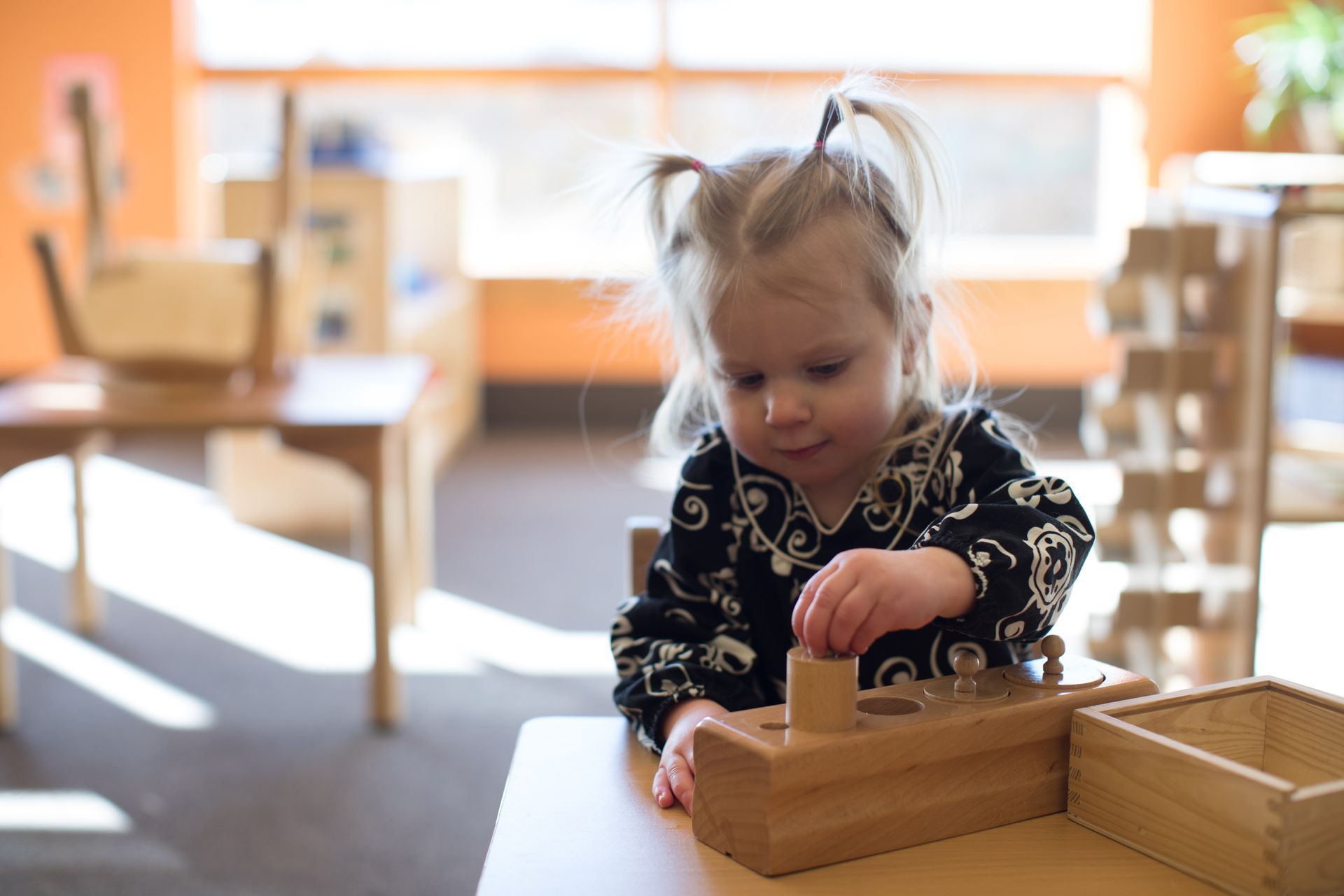
In Montessori classrooms, the process of writing begins long before children begin to hold a pencil. We start with rich oral language experiences, exploration of sounds, joyful movement, and a growing awareness that the symbols of written language carry meaning.


By the time children begin the recording process, that is, writing words on a surface, they have already done enormous preparation. They know the sandpaper letters so well that they can trace them blindfolded or “write” them in the air. They have composed countless words using the Moveable Alphabet, experimenting with sounds and meaning long before their hands are ready for conventional writing.


And then… one day… they are ready to put chalk to board.


This is the beginning of a beautiful and empowering journey.


The Materials That Support the Journey


To help children make the transition from forming words with the movable alphabet letters to recording them on a surface, we offer a thoughtfully prepared environment that can include:


  • Small chalkboards (blank, lined, or squared)
  • Large wall-mounted chalkboards
  • Containers of sharpened chalk and half-erasers
  • A writing supply station with paper in various narrow sizes
  • Pencils and underlays as needed
  • Accessible writing surfaces around the room


These materials invite practice without pressure, exploration without permanence, and repetition without fatigue, all of which are essential at this stage of development.


Step One: Writing Words with Chalk


When a child has composed a list of words with the Moveable Alphabet, the guide gently introduces the chalkboard: “Let me show you something you can do with the words on your rug.”


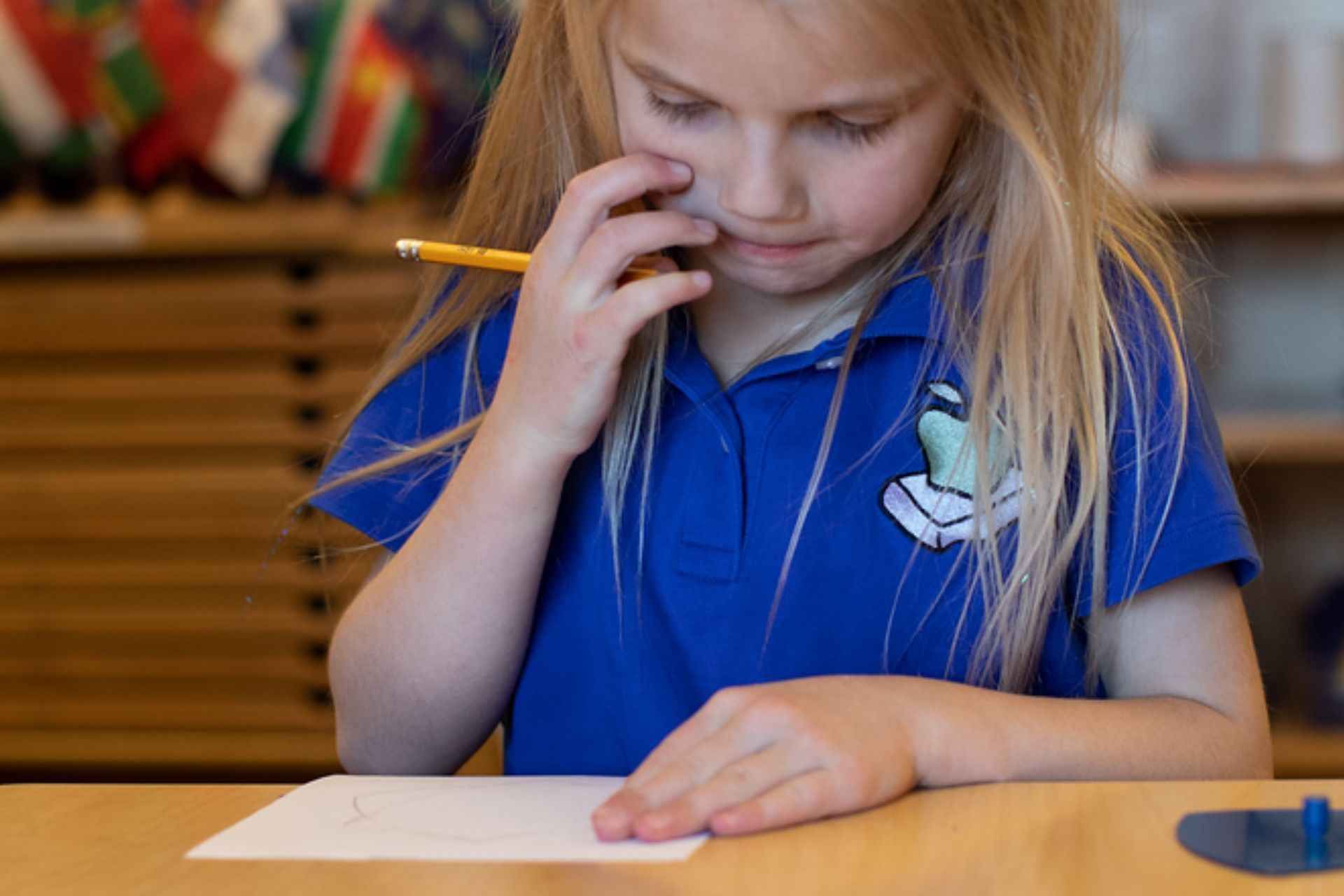
The child brings one word to the table, and the guide may make a point to notice how the letters connect and flow. With a piece of chalk in hand, the child can attempt to write the word on the chalkboard. For many children, this moment is astonishing, as they suddenly realize, “I can write!”


Over the next several days, the child chooses words, writes them, erases them, and writes again. During this time, the child naturally refines:


  • the direction of writing,
  • the connection between letters, and
  • the placement of letters along an invisible horizontal line.


This is joyful, purposeful work. And the chalkboard provides endless opportunities for clean slates!


Step Two: Introducing the Baseline


Once the child is comfortably writing words, we introduce the idea of a baseline, which is the line on which most letters sit.


We use a simple ruler to draw a single line across the chalkboard and explain: “I’m using this line to show where the letters sit.” 


The child thus begins to understand that writing follows a structure, including the realization that letters aren’t merely floating symbols but exist in space in predictable ways.


Step Three: Baseline and Waistline


As the child’s control increases, we add a second line: the waistline. This is the space where most lowercase letters rise up to, and introducing it helps children refine the size and placement of their script.


Using pastel chalk, we shade the space between the baseline and waistline, giving a soft visual guide. Over the next several days, the space becomes a little narrower. And then narrower still.


Eventually, the child works confidently on a nine-lined chalkboard, and from there, we transition to paper. Many children around five-and-a-half naturally begin to prefer writing directly on paper rather than returning to the Moveable Alphabet. They have internalized the shapes of letters, the structure of words, and the flow of writing.


It is important to remember: the natural size of children’s script varies. Some begin writing very small, others larger. We follow the child rather than a rigid sequence.


The ultimate goal is simple and elegant: to write confidently on a single line.


What This Work Supports


A child who moves through this sequence with joy and readiness:


  • develops beautiful, legible handwriting,
  • gains confidence in written expression, and
  • understands that writing is a tool for communication.


This is monumental work for a young child. It marks the moment when their mind and hand unite to express their own thoughts. Most importantly, writing unfolds naturally when the groundwork has been laid with care.


Schedule a tour of our school in Scottsdale, AZ, to see how we honor this journey with care and intention. 


September 28, 2026
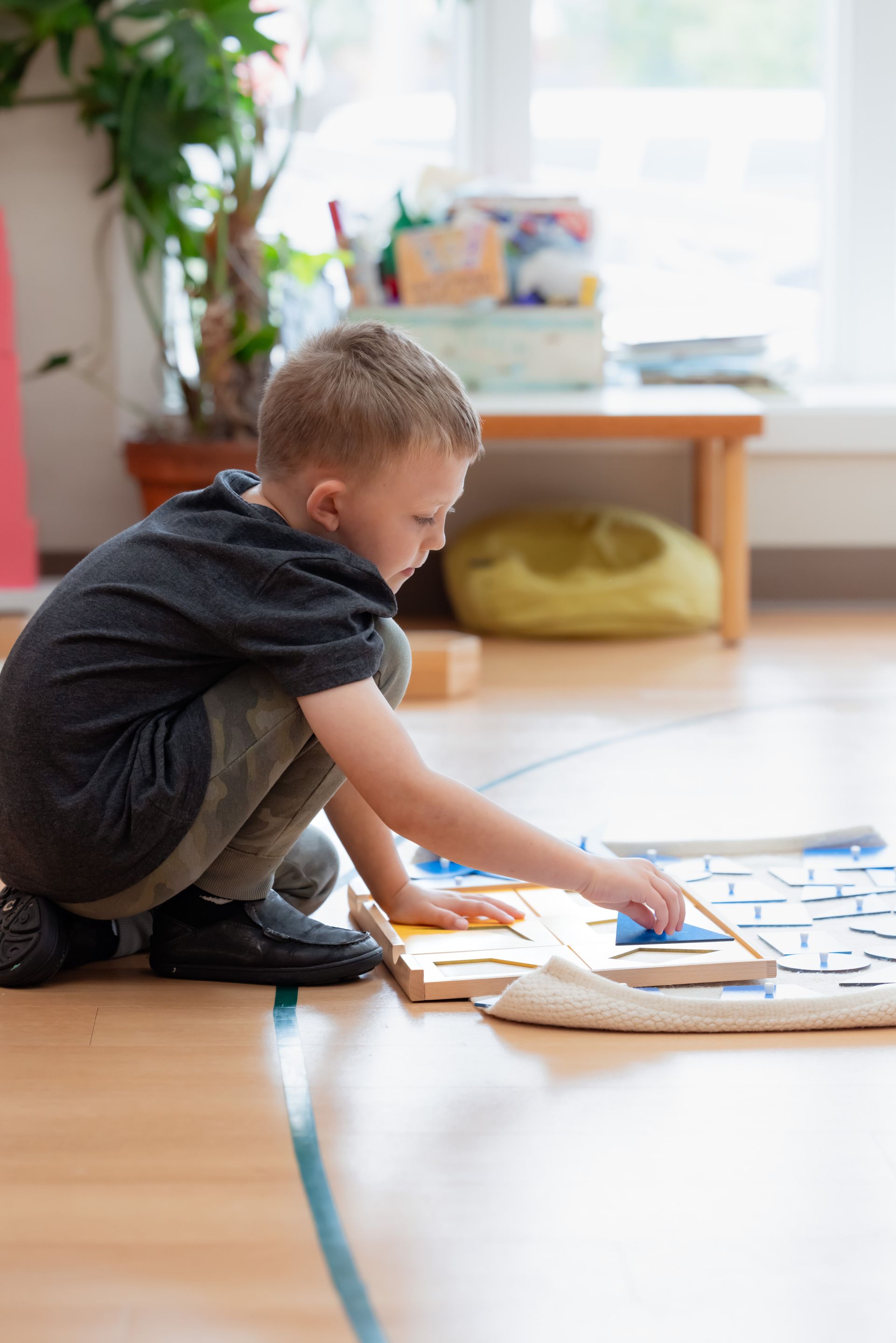
Nestled on a shelf in our Montessori Primary classrooms sits a distinct wooden cabinet filled with six to seven slim drawers. From the outside, it is simple and unassuming. Yet, when a child slides out a drawer, they reveal a beautifully arranged collection of vibrant blue geometric insets, each set inside a smooth wooden frame with a small brass knob in the center. As you explore through the drawers, you discover a rich world of plane geometry: circles that vary gracefully in diameter, rectangles that grow incrementally in width, a variety of triangles, regular polygons, quadrilaterals, and unique curved figures. This is the Geometry Cabinet —one of the most foundational and versatile materials in the Montessori Primary environment. Beyond introducing mathematical concepts, this captivating material enhances visual and muscular memory, develops critical language skills, and directly prepares the child’s hand for writing. A Concrete Foundation for Geometry First and foremost, the Geometry Cabinet introduces plane geometry through direct, hands-on experience. On top of the cabinet sits a demonstration tray containing three primary shapes: an equilateral triangle, a square, and a circle. These three figures form the bedrock of geometry: The Circle: Serves as the key to calculating angles. The Triangle: The fundamental constructing figure in geometry (and the polygon with the fewest possible sides). The Square: Used to measure area and represent four-sided polygons. In our Primary classrooms, guides use this demonstration tray to give children their very first impressions of these three essential figures, establishing a concrete foundation that will serve them through their Elementary years and beyond. A Tactile and Sensorimotor Experience Montessori learning always engages the senses. When introducing a shape from the cabinet, a guide demonstrates how to hold the shape by its small knob using the non-dominant hand while tracing the perimeter of the shape with the index and middle fingertips of the dominant hand. The child then traces the matching wooden outline in the drawer. This deliberate, meditative movement accomplishes two key developmental goals: Sensorial Discrimination: It gives the child a precise tactile impression of the shape’s physical boundaries. Motor Preparation for Writing: It refines fine motor control, hand-eye coordination, and spatial awareness—all essential prerequisites for holding a pencil and writing. As children gain confidence, they progress from tracing single shapes to mixing up multiple drawers and matching shapes back into their frames. To further refine their tactile sense, children often perform this work while wearing a blindfold, relying entirely on their sense of touch! From Concrete Material to Abstract Symbols As children master the physical insets, we introduce three distinct sets of cards for each geometric shape: Solid Cards: The shape is filled in completely. Thick Outline Cards: The shape is represented by a thick outer line. Thin Outline Cards: The shape is represented by a delicate, thin outer line. The child selects a physical wooden inset, searches through the cards, and places the concrete shape directly onto its matching abstract card. This work bridges the gap between concrete objects and abstract symbols—a vital step in learning to read. If a child can distinguish the subtle visual differences between a trapezoid and a parallelogram, they can easily differentiate between written letter forms like a cursive b and z. Through the Geometry Cabinet, children internalize the reality that symbols are simply shapes defined by lines. Rich, Precise Language Acquisition Young children absorb precise terminology with remarkable ease. Rather than using simplified terms, Montessori guides provide exact geometric nomenclature. As children work with the Geometry Cabinet, they effortlessly learn and apply precise vocabulary: Quadrilaterals: Rhombus, parallelogram, isosceles trapezoid, right-angled trapezoid. Curved Figures: Oval, ellipse, quatrefoil. Triangles: Equilateral, right-angled isosceles, acute-angled scalene, obtuse-angled scalene. Polygons: Pentagon, hexagon, heptagon, octagon, nonagon, decagon. Rather than seeing just a "triangle," a Montessori child learns to observe and categorize shapes based on their distinct angles and sides, expanding their vocabulary while building mental classification skills. Movement, Memory, and Spatial Awareness To deepen concentration and exercise memory, guides introduce a series of interactive movement games with the Geometry Cabinet: Distance Matching: A shape is placed on one side of the room while its frame remains on the other. The child must hold the precise visual and tactile memory of the shape as they walk across the room to find its match. Environmental Discovery: Children search the classroom to find real-world objects that match a specific geometric inset, bridging the gap between isolated materials and the physical environment around them. Collaborative Grading: Children work together to arrange a set of shapes (such as circles increasing in diameter) in precise sequential order—sometimes even holding shapes behind their backs to arrange them strictly by touch! A Thoughtfully Prepared Tool for Lifelong Learning While the primary goal of the Geometry Cabinet is to cultivate visual and tactile shape discrimination, its benefits extend into every area of early childhood development: Pincer Grip Development: Grasping the small wooden knobs naturally strengthens the muscles needed for pencil hold. Concentration and Focus: The self-correcting nature of the material encourages long periods of deep engagement. Language and Literacy Preparation: Distinguishing fine lines and angles builds the visual discrimination necessary for letter and number recognition. The Geometry Cabinet is a prime example of how Montessori materials transform complex mathematical concepts into joyfully accessible, hands-on discovery. Experience Our Classrooms Firsthand We invite you to see how our prepared environments foster deep concentration, independence, and a lifelong love for learning. Schedule a tour today!
Toddler working  with wooden blocks at a classroom table, reaching into a small wooden box.
September 21, 2026
Reflect on what truly matters in education. Mission Montessori Academy explores how alignment with core values—like empathy, independence, and critical thinking—prepares children for life, not just the workforce.