
Our Montessori Dictionary

December 30, 2024

We recognize that Montessori education can have some lingo that might need a little explanation. So in this Montessori Dictionary post, we’re going to focus on a few terms (some familiar, some perhaps not so familiar) that apply to both the early childhood years and beyond. 


When possible, we’ve included some quotes from Dr. Maria Montessori and we encourage you to take a look at her work. Dr. Montessori was a woman well before her time and her books, such as From Childhood to Adolescence and To Educate the Human Potential, can be a source of insight and inspiration!


Grace and Courtesy


Grace and courtesy is an essential aspect of Montessori environments and supports children as they develop social relationships. Grace is how we move through the space around us, and courtesy is how we treat each other. 


In the Montessori primary classroom, grace and courtesy is considered one of the areas of practical life. For example, adults give lessons on how to interrupt, how to accept an offering, how to offer help, or how to introduce oneself. These lessons are offered in small groups and the technique used is role-playing. Little social scenarios are acted out and provide a model for behavior that is situational. Like all other learning activities, grace and courtesy lessons are practiced and repeated. They provide a respectful way of learning expectations and aiding social skills before they are needed.


Grace and courtesy is never offered as a form of punishment or correction. We make sure children don’t experience embarrassment by being corrected by adults on the spot, as this makes children feel disrespected and not safe. Dr. Montessori reminds us of this in The Secret of Childhood: “I have come to appreciate the fact that children have a deep sense of personal dignity. Adults, as a rule, have no concept of how easily they are wounded and oppressed.” In time, if we offer these grace and courtesy lessons, and give children a safe place to practice, children will eventually perform these skills independently. 


Human Tendencies


Human tendencies are unconscious, universal drives that support our adaptation to our particular time and place. All humans are born with innate needs and drives and are wired to adapt to their environment. The human tendencies – to orient, explore, order, abstract, imagine, calculate, work, be exact and repeat, perfect oneself, and communicate and associate with others – help aid this adaptation.  


Dr. Montessori alluded to human tendencies when she wrote about the inner drive she observed in children and how this drive helps individuals construct themselves to develop into maturity: “Their behavior led us to become aware of a fundamental truth, namely that the child works for his own inner development and not to reach an exterior aim and that when he has done this work he has not really developed a special ability but he has developed something in himself.” 


Prepared Environment


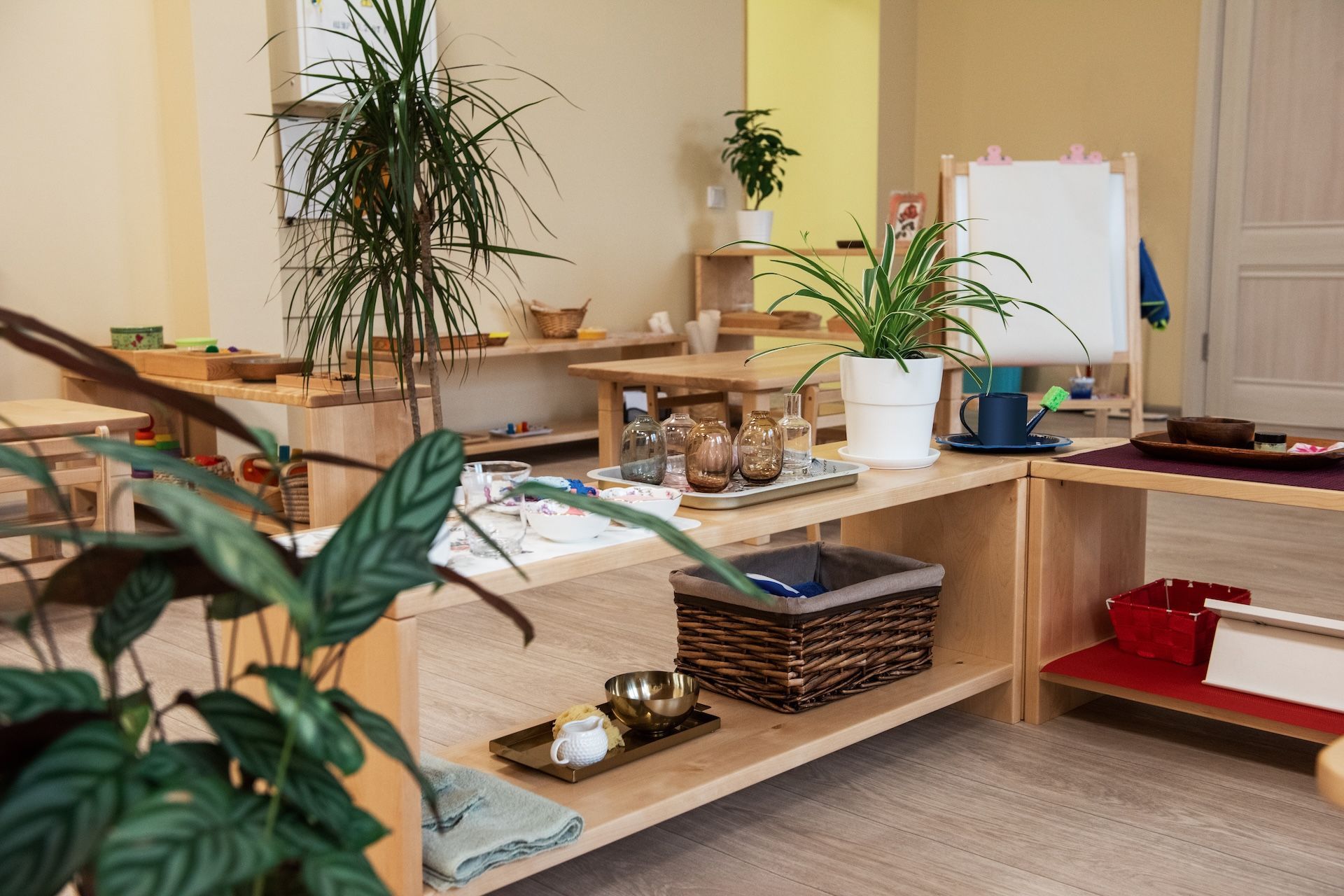
The Montessori environment is carefully prepared so that children can satisfy their human tendencies and thus develop to their fullest potential. The prepared environment takes into consideration what children need at their particular stage of growth, and as individuals on their own trajectory of development. The prepared environment consists of the physical and psychic aspects of the environment, of which the adult is a key part. 


Through interactions in a prepared environment, children can construct who they are as human beings. As they go through this process of self-construction in their environment, children learn, grow, adapt, and create. The prepared environment is part of the triad of the child, the environment, and the adult, all of which are interconnected components. 


Sensitive Periods/Sensitivities


Dr. Montessori was first and foremost a scientist and she was interested in what was happening prior to observable signs of human development. She was curious about what was going on in the mind before the skill manifested itself. For example, she wanted to know what was happening during the many months prior to children speaking their first word. 


Without the high-tech tools that neuropsychologists and psychologists now have to measure brain activity, Dr. Montessori had to rely upon observation. She watched children, took notes, and made charts about what they did. As a result, she discovered that a particular object or aspect of the environment would have an irresistible draw for children. This attraction would last for some time. Children would keep going back to the same activity or element of the environment and would be continually drawn to it. Then the day would come when it held no more interest and something new would be attractive. 


Dr. Montessori observed this phenomenon over and over again, which led her to believe that there must be something innate in children that was driving this interest. Building upon the work of biologists, Dr. Montessori adopted the term, sensitive period, to describe transitory periods of psychic development. Beyond the Montessori world, sensitive periods are now referred to as critical periods or windows of opportunity. 


What does a school look like that focuses first on grace and courtesy, human tendencies, a prepared environment, and sensitive periods? Schedule a tour to see for yourself!
September 28, 2026
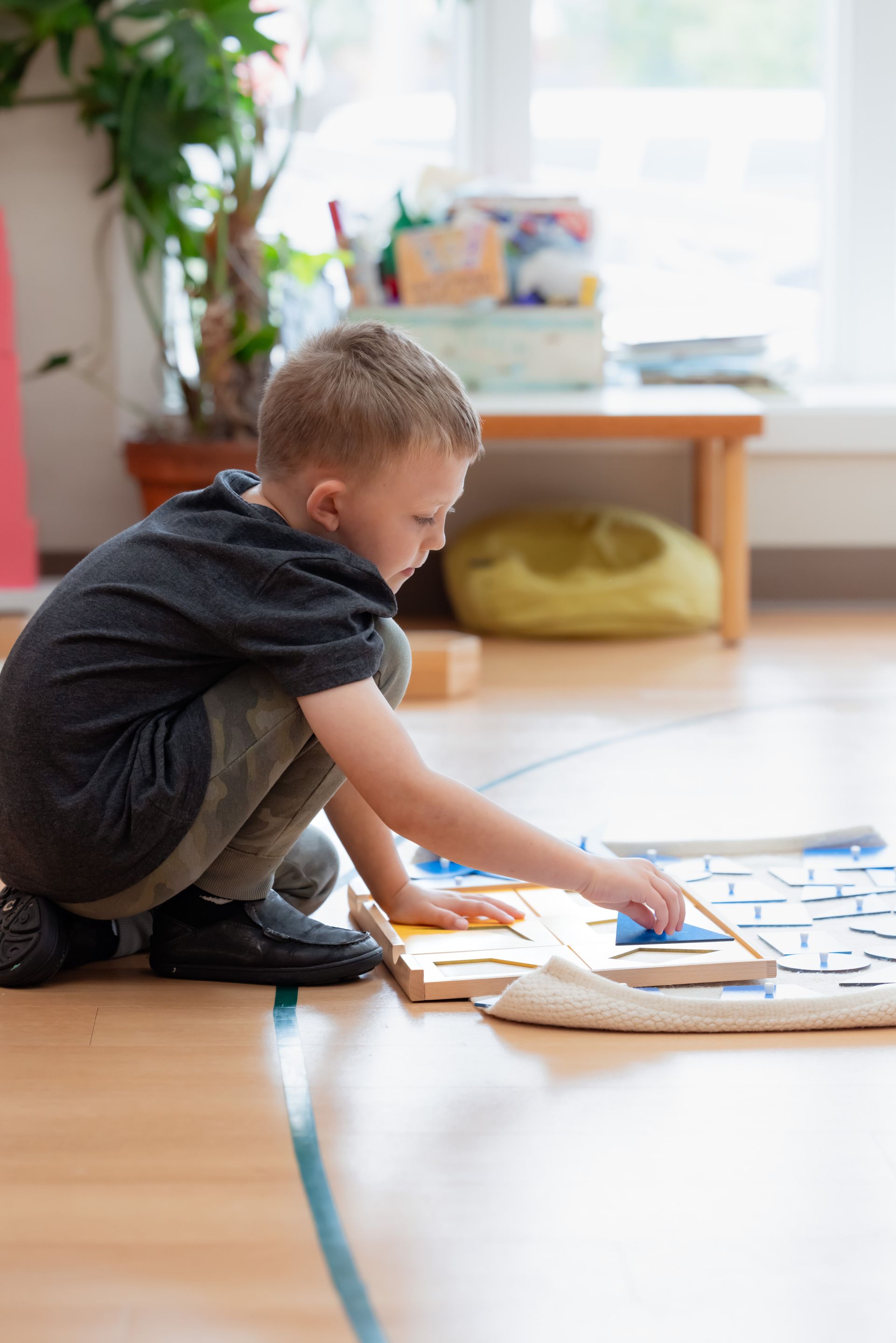
Nestled on a shelf in our Montessori Primary classrooms sits a distinct wooden cabinet filled with six to seven slim drawers. From the outside, it is simple and unassuming. Yet, when a child slides out a drawer, they reveal a beautifully arranged collection of vibrant blue geometric insets, each set inside a smooth wooden frame with a small brass knob in the center. As you explore through the drawers, you discover a rich world of plane geometry: circles that vary gracefully in diameter, rectangles that grow incrementally in width, a variety of triangles, regular polygons, quadrilaterals, and unique curved figures. This is the Geometry Cabinet —one of the most foundational and versatile materials in the Montessori Primary environment. Beyond introducing mathematical concepts, this captivating material enhances visual and muscular memory, develops critical language skills, and directly prepares the child’s hand for writing. A Concrete Foundation for Geometry First and foremost, the Geometry Cabinet introduces plane geometry through direct, hands-on experience. On top of the cabinet sits a demonstration tray containing three primary shapes: an equilateral triangle, a square, and a circle. These three figures form the bedrock of geometry: The Circle: Serves as the key to calculating angles. The Triangle: The fundamental constructing figure in geometry (and the polygon with the fewest possible sides). The Square: Used to measure area and represent four-sided polygons. In our Primary classrooms, guides use this demonstration tray to give children their very first impressions of these three essential figures, establishing a concrete foundation that will serve them through their Elementary years and beyond. A Tactile and Sensorimotor Experience Montessori learning always engages the senses. When introducing a shape from the cabinet, a guide demonstrates how to hold the shape by its small knob using the non-dominant hand while tracing the perimeter of the shape with the index and middle fingertips of the dominant hand. The child then traces the matching wooden outline in the drawer. This deliberate, meditative movement accomplishes two key developmental goals: Sensorial Discrimination: It gives the child a precise tactile impression of the shape’s physical boundaries. Motor Preparation for Writing: It refines fine motor control, hand-eye coordination, and spatial awareness—all essential prerequisites for holding a pencil and writing. As children gain confidence, they progress from tracing single shapes to mixing up multiple drawers and matching shapes back into their frames. To further refine their tactile sense, children often perform this work while wearing a blindfold, relying entirely on their sense of touch! From Concrete Material to Abstract Symbols As children master the physical insets, we introduce three distinct sets of cards for each geometric shape: Solid Cards: The shape is filled in completely. Thick Outline Cards: The shape is represented by a thick outer line. Thin Outline Cards: The shape is represented by a delicate, thin outer line. The child selects a physical wooden inset, searches through the cards, and places the concrete shape directly onto its matching abstract card. This work bridges the gap between concrete objects and abstract symbols—a vital step in learning to read. If a child can distinguish the subtle visual differences between a trapezoid and a parallelogram, they can easily differentiate between written letter forms like a cursive b and z. Through the Geometry Cabinet, children internalize the reality that symbols are simply shapes defined by lines. Rich, Precise Language Acquisition Young children absorb precise terminology with remarkable ease. Rather than using simplified terms, Montessori guides provide exact geometric nomenclature. As children work with the Geometry Cabinet, they effortlessly learn and apply precise vocabulary: Quadrilaterals: Rhombus, parallelogram, isosceles trapezoid, right-angled trapezoid. Curved Figures: Oval, ellipse, quatrefoil. Triangles: Equilateral, right-angled isosceles, acute-angled scalene, obtuse-angled scalene. Polygons: Pentagon, hexagon, heptagon, octagon, nonagon, decagon. Rather than seeing just a "triangle," a Montessori child learns to observe and categorize shapes based on their distinct angles and sides, expanding their vocabulary while building mental classification skills. Movement, Memory, and Spatial Awareness To deepen concentration and exercise memory, guides introduce a series of interactive movement games with the Geometry Cabinet: Distance Matching: A shape is placed on one side of the room while its frame remains on the other. The child must hold the precise visual and tactile memory of the shape as they walk across the room to find its match. Environmental Discovery: Children search the classroom to find real-world objects that match a specific geometric inset, bridging the gap between isolated materials and the physical environment around them. Collaborative Grading: Children work together to arrange a set of shapes (such as circles increasing in diameter) in precise sequential order—sometimes even holding shapes behind their backs to arrange them strictly by touch! A Thoughtfully Prepared Tool for Lifelong Learning While the primary goal of the Geometry Cabinet is to cultivate visual and tactile shape discrimination, its benefits extend into every area of early childhood development: Pincer Grip Development: Grasping the small wooden knobs naturally strengthens the muscles needed for pencil hold. Concentration and Focus: The self-correcting nature of the material encourages long periods of deep engagement. Language and Literacy Preparation: Distinguishing fine lines and angles builds the visual discrimination necessary for letter and number recognition. The Geometry Cabinet is a prime example of how Montessori materials transform complex mathematical concepts into joyfully accessible, hands-on discovery. Experience Our Classrooms Firsthand We invite you to see how our prepared environments foster deep concentration, independence, and a lifelong love for learning. Schedule a tour today!
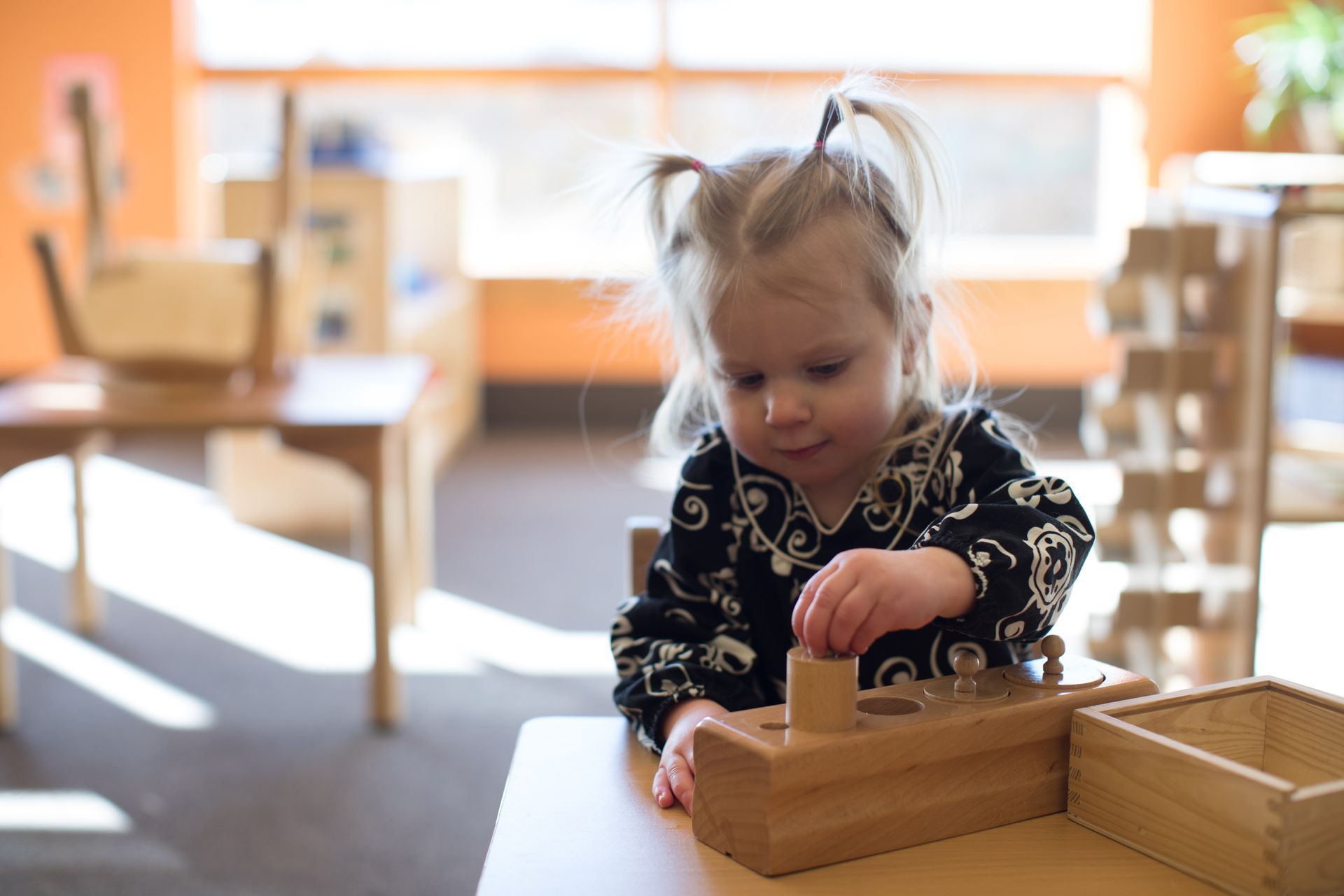
Toddler working  with wooden blocks at a classroom table, reaching into a small wooden box.
September 21, 2026
Reflect on what truly matters in education. Mission Montessori Academy explores how alignment with core values—like empathy, independence, and critical thinking—prepares children for life, not just the workforce.