Nearly 120 years ago, when Dr. Maria Montessori established the first Casa dei Bambini (Children’s House) in Rome, she observed a remarkable development. Young children—whom society at the time assumed were far too young for formal academic instruction—began showing a deep interest in words, letters, and self-expression.
Driven by these observations, Dr. Montessori isolated the foundational skills required for communication and created intentional materials to support them. The result was what she famously described as an "explosion" into writing and reading—a natural, joyful emergence of literacy built on a foundation of self-directed practice.
At Mission Montessori Academy, we guide children through this process by supporting three distinct, interconnected aspects of language acquisition: spoken language, written expression, and interpretive reading.
1. Spoken Language: The Foundation
Spoken language is the bedrock of all literacy. Long before a child picks up a pencil or decodes a word, they must possess a rich internal vocabulary and the confidence to express their thoughts.
In our classrooms, guides enrich spoken language continuously throughout the day:
- Vocabulary Expansion: We use precise, rich terminology across all curriculum areas—naming specific botanical parts, geometric shapes, and practical tools rather than using generic terms.
- Conversational Skills: Through language games, storytelling, and group discussions, children refine their auditory discrimination, listening comprehension, and turn-taking skills.
- Valuing the Child’s Voice: Guides make time to listen attentively to each child’s spontaneous expressions, reinforcing that their thoughts are meaningful and worthy of being shared.
2. Written Expression: Preparing Mind and Hand
In traditional educational settings, reading is typically taught before writing. In the Montessori approach, written expression comes first.
Writing is fundamentally the encoding of one's own thoughts—moving from a known sound to a visual symbol. Because you already know what you want to say, encoding is cognitively more accessible to a young child than decoding someone else's written thoughts.
Writing involves two distinct tasks: composing (the mental process of formulating ideas) and recording (the physical mechanics of handwriting). We prepare these two skills separately so that physical limitations do not impede intellectual expression:
- Preparing the Hand (Mechanics): Long before holding a pencil, children build fine motor strength, pincer grasp, and lightness of touch through Practical Life and Sensorial materials. Tracing metal insets, carrying knobbed cylinder blocks, and using water-pouring activities all directly develop the hand muscles needed for writing.
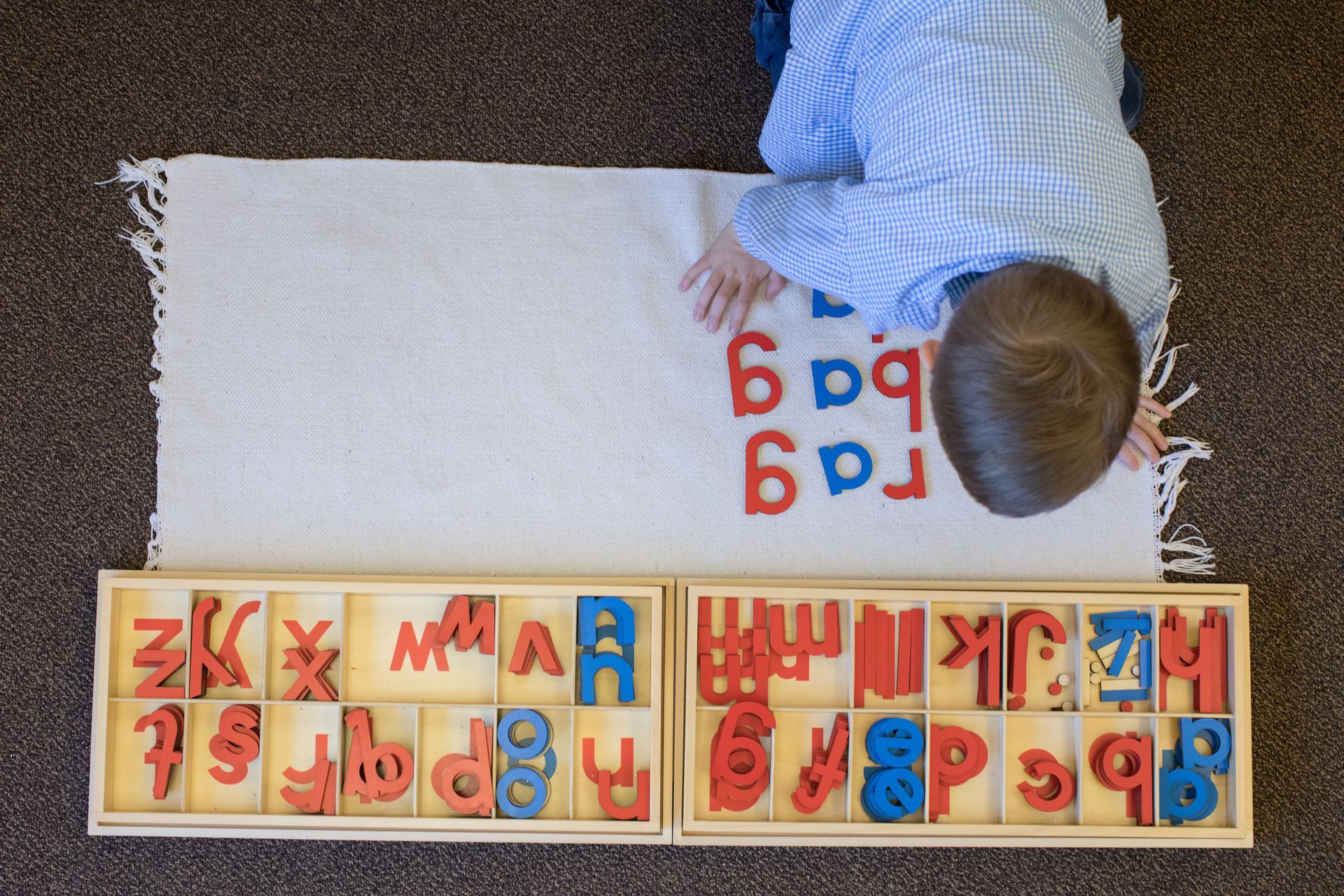
- Preparing the Mind (Composition): To compose words before the hand can control a pencil, children use the Movable Alphabet. This material consists of wooden alphabet cutouts organized by sound. A child can construct full words, phrases, and stories on a work mat simply by organizing the phonetic symbols for the sounds they hear in their mind.
3. Interpretive Reading: Decoding Thought
Reading is the process of taking written symbols created by another person, translating those symbols into sounds, blending those sounds together, and extracting meaning. Because it requires decoding another person’s mind, it is cognitively more complex than writing.
To prepare children for reading, we carefully train visual discrimination and tracking:
- Visual & Spatial Tracking: The eye must learn to move smoothly from left to right and top to bottom. Every practical life exercise—such as washing a table or dusting a shelf—is presented using this left-to-right, top-to-bottom pattern to build muscle memory for reading.
- Tactile & Auditory Association: Using Sandpaper Letters, children trace the shape of a letter with their index and middle fingers while pronouncing its phonetic sound. This multi-sensory association engages touch, sight, and hearing simultaneously.
- Syntax and Function: As children begin reading words, phrases, and short sentences, we introduce grammar activities using color-coded symbols to illustrate word function (nouns, verbs, adjectives). Reading analysis exercises help children understand sentence structure, deepening their reading comprehension.
Following the Natural Pattern of Human History
The Montessori language sequence—moving from Spoken Language → Written Expression → Interpretive Reading—mirrors the historic evolution of human communication. Early human societies communicated verbally first, transitioned into visual symbols and cave markings (writing), and ultimately developed standardized written systems for others to decode (reading).
Because our curriculum honors this natural sequence, language learning feels intuitive rather than frustrating for young children.
Every element of a Mission Montessori Academy classroom contributes to this journey:
- Knobbed cylinder handles prepare the finger muscles for a pencil grip.
- Touch tablets develop the tactile sensitivity required for delicate paper work.
- Sound games (like "I Spy") help children isolate individual phonemes within spoken words.
By breaking complex capabilities down into isolated, manageable steps, children build mastery naturally. When these underlying components come together, the "explosion" into writing and reading occurs effortlessly from within the child.
Experience Language in Action
Watching a young child realize they can read or write their own thoughts is one of the greatest joys of Montessori education. We invite you to visit Mission Montessori Academy to observe our prepared environments and see this language sequence in practice.
Schedule a Tour Today to learn more about our programs and admissions process.