
The Power of a Mirror and a Tissue

August 25, 2025

In their journey toward independence, one of the earliest and most meaningful steps children take is learning to care for themselves. In Montessori, this essential area of development is part of what we call Practical Life, which supports both physical and psychological growth.


A Prepared Environment for Self-Care


Montessori environments are intentionally designed to foster this growth. Everything is made accessible at the child's level: a sink they can reach, a faucet they can operate, and soap measured just right for a small hand. We carefully choose and arrange the materials to promote independence, order, and confidence.


We ensure that activities that may have once been done to children—like washing hands, brushing hair, or putting on a coat—can now be done by children, with increasing skill and pride. These seemingly simple tasks carry profound developmental weight, reinforcing our children’s self-concept and strengthening their ability to function with increasing autonomy.


Learning to Care for the Self: Wiping the Nose


In the Montessori approach, even the simplest daily tasks are viewed as meaningful opportunities for children to build independence and confidence. One such task—often overlooked by adults but deeply empowering for children—is learning how to wipe their own nose.


This Practical Life activity is typically introduced around age one, or when a child enters a Montessori classroom. It is designed not only to support hygiene but also to encourage autonomy, intentional movement, and body care.


This activity can also be introduced at home!


A Prepared Environment for Self-Care


To support this important developmental step, first think about how to carefully prepare the environment:


  • Set up a small basket or container that holds about 10 tissues, each folded in half. (During cold season, full-size tissues may be used for greater effectiveness.)
  • Place a small trash can nearby for easy disposal.
  • Have a mirror, either mounted or resting at the child’s height, to allow your child to observe their own face and movements.
  • Store extra tissues nearby, either on a grooming table or supply shelf, to support repetition and independence.


This setup encourages children to move freely and participate fully in the process, fostering both confidence and coordination.


Step-by-Step: The Wiping Process


Next, we can model and provide gentle guidance:


  • Invite your child to come to the mirror.
  • Help them notice something on their nose and explain the purpose of the activity.
  • Show the tissues and select one, unfolding it slowly and deliberately.
  • Invite your child to select and open a tissue.
  • Face the mirror and demonstrate how to place the tissue so each half forms a “tent” over the nose.
  • Gently bring the tissue edges together and wipe upward and outward.
  • Fold the tissue in half, then rotate it and repeat with the other side.
  • Use the remaining clean section to dab gently under the nose.
  • Dispose of the tissue in the trash.
  • Invite your child to have a turn and, if needed, show the mucus on the tissue as a reference.
  • Encourage repetition with a new tissue if their nose is not yet clean.
  • Remind your child that they may wipe their nose anytime.
  • Follow up with handwashing to reinforce cleanliness.


If your child has excessive mucus or needs a more thorough cleaning, you can also use pre-moistened wipes. We typically don’t introduce nose blowing until around age 2.5 to 3 to avoid the risk of ear infections.


When introducing this activity, it is helpful to consider its overarching purposes. First and foremost, learning how to wipe one’s own nose helps support independence and confidence. The process also helps children develop self-awareness and tools for self-care. 


We can also highlight certain movements so our children achieve success. In Montessori, we call these “points of interest.” The key points of interest in this activity are:


  • Watching their own movements in the mirror
  • Observing the removal of mucus from their face
  • The folding and unfolding of the tissue
  • Practicing care not to touch the mouth during wiping


A Foundation for Independence & Self-Awareness


In Montessori, every Practical Life activity serves a deeper purpose. Even wiping the nose becomes a pathway to self-discovery, dignity, and joyful independence. By breaking down the steps and offering repeated, respectful invitations to participate, we give children the tools they need to become gracefully self-aware and independent!


Care of oneself is about far more than hygiene or appearance. These early experiences shape children’s understanding of their place in the world and prepare them to become responsible, confident, and independent human beings.


In Montessori, self-care is not a chore. Rather, it’s a celebration of children’s unfolding independence. Come visit our school to learn more about activities that cultivate children’s capability and self-respect. 


Pumpkins stacked on wooden pallets at an outdoor market stall
October 5, 2026
Discover Montessori-aligned ways to celebrate autumn with your child! Explore hands-on pumpkin activities, practical life kitchen skills, life cycle lessons, and seasonal math for young learners.
September 28, 2026
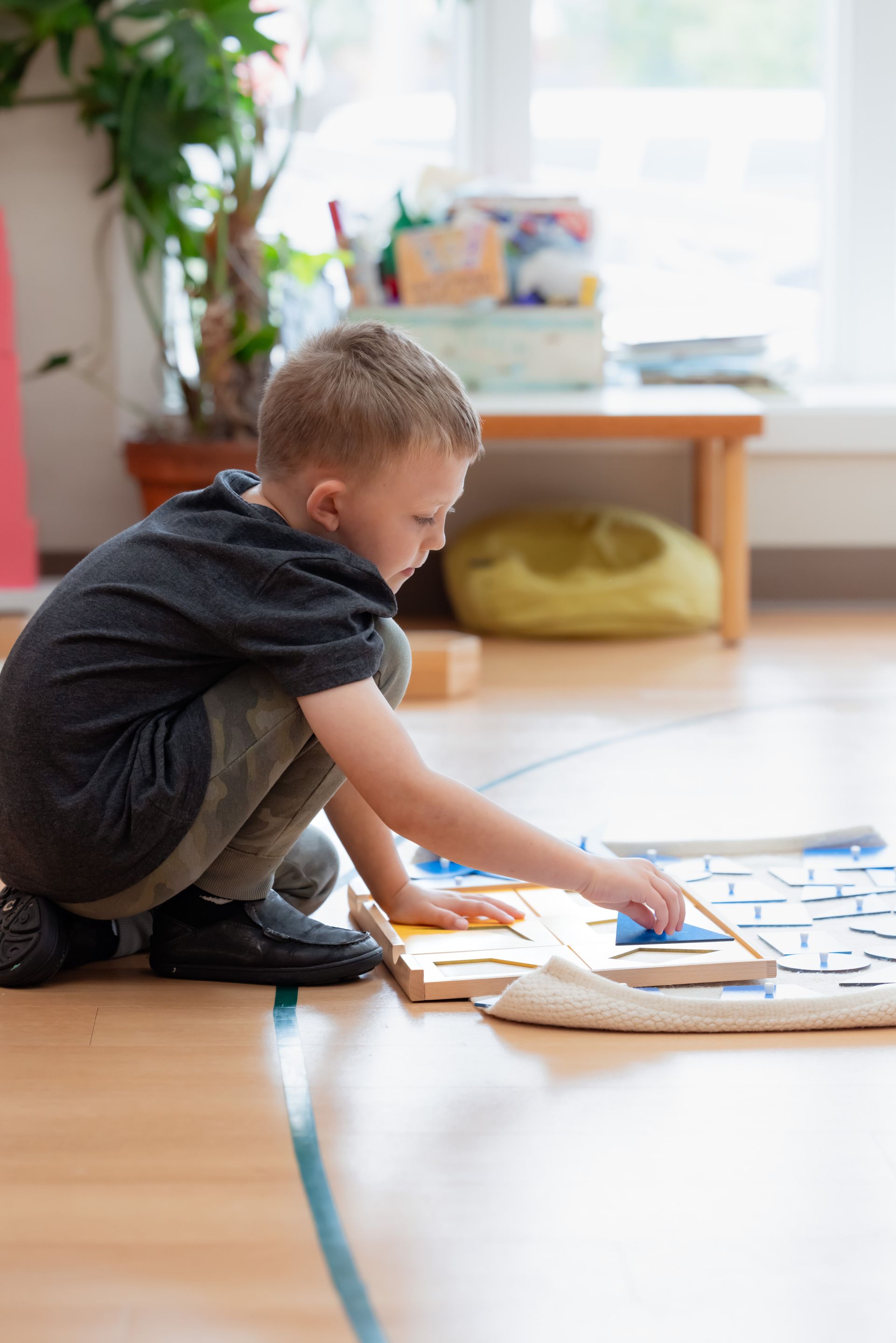
Nestled on a shelf in our Montessori Primary classrooms sits a distinct wooden cabinet filled with six to seven slim drawers. From the outside, it is simple and unassuming. Yet, when a child slides out a drawer, they reveal a beautifully arranged collection of vibrant blue geometric insets, each set inside a smooth wooden frame with a small brass knob in the center. As you explore through the drawers, you discover a rich world of plane geometry: circles that vary gracefully in diameter, rectangles that grow incrementally in width, a variety of triangles, regular polygons, quadrilaterals, and unique curved figures. This is the Geometry Cabinet —one of the most foundational and versatile materials in the Montessori Primary environment. Beyond introducing mathematical concepts, this captivating material enhances visual and muscular memory, develops critical language skills, and directly prepares the child’s hand for writing. A Concrete Foundation for Geometry First and foremost, the Geometry Cabinet introduces plane geometry through direct, hands-on experience. On top of the cabinet sits a demonstration tray containing three primary shapes: an equilateral triangle, a square, and a circle. These three figures form the bedrock of geometry: The Circle: Serves as the key to calculating angles. The Triangle: The fundamental constructing figure in geometry (and the polygon with the fewest possible sides). The Square: Used to measure area and represent four-sided polygons. In our Primary classrooms, guides use this demonstration tray to give children their very first impressions of these three essential figures, establishing a concrete foundation that will serve them through their Elementary years and beyond. A Tactile and Sensorimotor Experience Montessori learning always engages the senses. When introducing a shape from the cabinet, a guide demonstrates how to hold the shape by its small knob using the non-dominant hand while tracing the perimeter of the shape with the index and middle fingertips of the dominant hand. The child then traces the matching wooden outline in the drawer. This deliberate, meditative movement accomplishes two key developmental goals: Sensorial Discrimination: It gives the child a precise tactile impression of the shape’s physical boundaries. Motor Preparation for Writing: It refines fine motor control, hand-eye coordination, and spatial awareness—all essential prerequisites for holding a pencil and writing. As children gain confidence, they progress from tracing single shapes to mixing up multiple drawers and matching shapes back into their frames. To further refine their tactile sense, children often perform this work while wearing a blindfold, relying entirely on their sense of touch! From Concrete Material to Abstract Symbols As children master the physical insets, we introduce three distinct sets of cards for each geometric shape: Solid Cards: The shape is filled in completely. Thick Outline Cards: The shape is represented by a thick outer line. Thin Outline Cards: The shape is represented by a delicate, thin outer line. The child selects a physical wooden inset, searches through the cards, and places the concrete shape directly onto its matching abstract card. This work bridges the gap between concrete objects and abstract symbols—a vital step in learning to read. If a child can distinguish the subtle visual differences between a trapezoid and a parallelogram, they can easily differentiate between written letter forms like a cursive b and z. Through the Geometry Cabinet, children internalize the reality that symbols are simply shapes defined by lines. Rich, Precise Language Acquisition Young children absorb precise terminology with remarkable ease. Rather than using simplified terms, Montessori guides provide exact geometric nomenclature. As children work with the Geometry Cabinet, they effortlessly learn and apply precise vocabulary: Quadrilaterals: Rhombus, parallelogram, isosceles trapezoid, right-angled trapezoid. Curved Figures: Oval, ellipse, quatrefoil. Triangles: Equilateral, right-angled isosceles, acute-angled scalene, obtuse-angled scalene. Polygons: Pentagon, hexagon, heptagon, octagon, nonagon, decagon. Rather than seeing just a "triangle," a Montessori child learns to observe and categorize shapes based on their distinct angles and sides, expanding their vocabulary while building mental classification skills. Movement, Memory, and Spatial Awareness To deepen concentration and exercise memory, guides introduce a series of interactive movement games with the Geometry Cabinet: Distance Matching: A shape is placed on one side of the room while its frame remains on the other. The child must hold the precise visual and tactile memory of the shape as they walk across the room to find its match. Environmental Discovery: Children search the classroom to find real-world objects that match a specific geometric inset, bridging the gap between isolated materials and the physical environment around them. Collaborative Grading: Children work together to arrange a set of shapes (such as circles increasing in diameter) in precise sequential order—sometimes even holding shapes behind their backs to arrange them strictly by touch! A Thoughtfully Prepared Tool for Lifelong Learning While the primary goal of the Geometry Cabinet is to cultivate visual and tactile shape discrimination, its benefits extend into every area of early childhood development: Pincer Grip Development: Grasping the small wooden knobs naturally strengthens the muscles needed for pencil hold. Concentration and Focus: The self-correcting nature of the material encourages long periods of deep engagement. Language and Literacy Preparation: Distinguishing fine lines and angles builds the visual discrimination necessary for letter and number recognition. The Geometry Cabinet is a prime example of how Montessori materials transform complex mathematical concepts into joyfully accessible, hands-on discovery. Experience Our Classrooms Firsthand We invite you to see how our prepared environments foster deep concentration, independence, and a lifelong love for learning. Schedule a tour today!